Better Hardware, Better Research - workshops
Project Arlo - Bridge Rectifier, Hebden Bridge
A chance meeting with a member of the Bridge Rectifier hackerspace at the FDRI Open Source Hardware workshop led to a bonus workshop in the series. The Fellowship funded the equipment for an introductory LoRaWAN workshop at Bridge Rectifier makerspace, Hebden Bridge, on Sunday 14 June 2026. The aim was to test and develop Project Arlo, a web-based tool for programming and configuring sensors in a workshop setting, so that newcomers don't have to grapple with code IDEs or commandline tools. The award was matched by the DATA project (From Extraction to Exchange), which covered the sensor boards, catering and student travel. Julian Brooks did the organising and logistics, and this is their writeup:
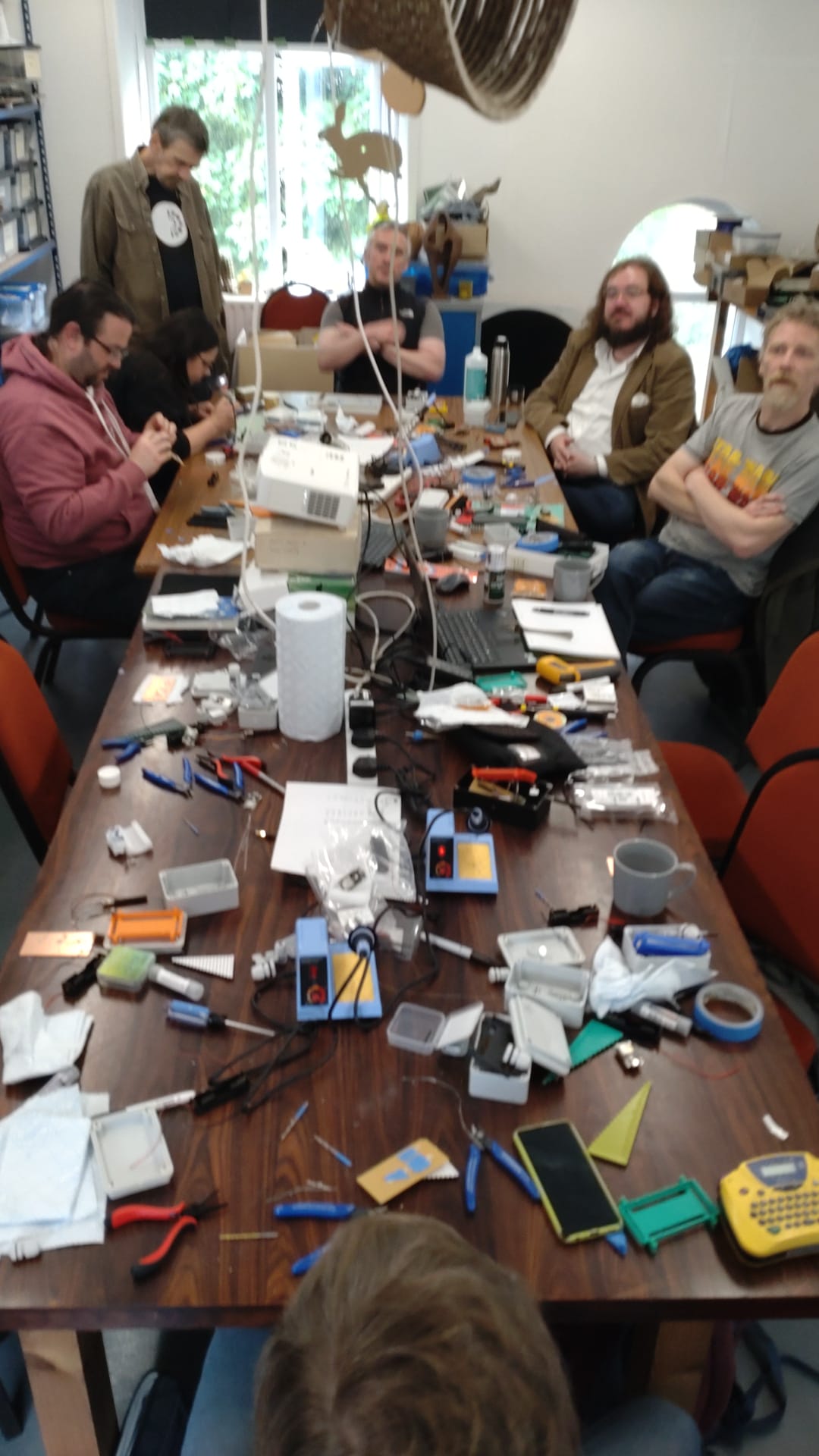
Twelve people took part, ten of them new to the hackspace and the project, supported by three to five Bridge Rectifier members. The first part of the day was hands-on. A complete working system ran on site: sensor nodes, a LoRaWAN gateway, a network server and a live dashboard showing readings as they arrived. Participants soldered and assembled sensor nodes alongside experienced members. Lunch was provided by Jan and Guy Lymer, and it was one of the highlights of the day, followed by a short walk.
For the afternoon, everyone sat in one large circle in the downstairs workshop, among the tools, starting from a single question: what should we do next? The hours of technical work before it gave everyone a shared footing, and the conversation drew on real insight and experience from people in the room. It changed our direction. It convinced us to set up a community co-operative and to make the project's work more community-facing. Participants asked to keep meeting and building, and a local network of people interested in environmental sensing has formed around it. The award also left four soldering stations, three electronics toolkits, hand tools and spare sensors at Bridge Rectifier for its ongoing sessions.
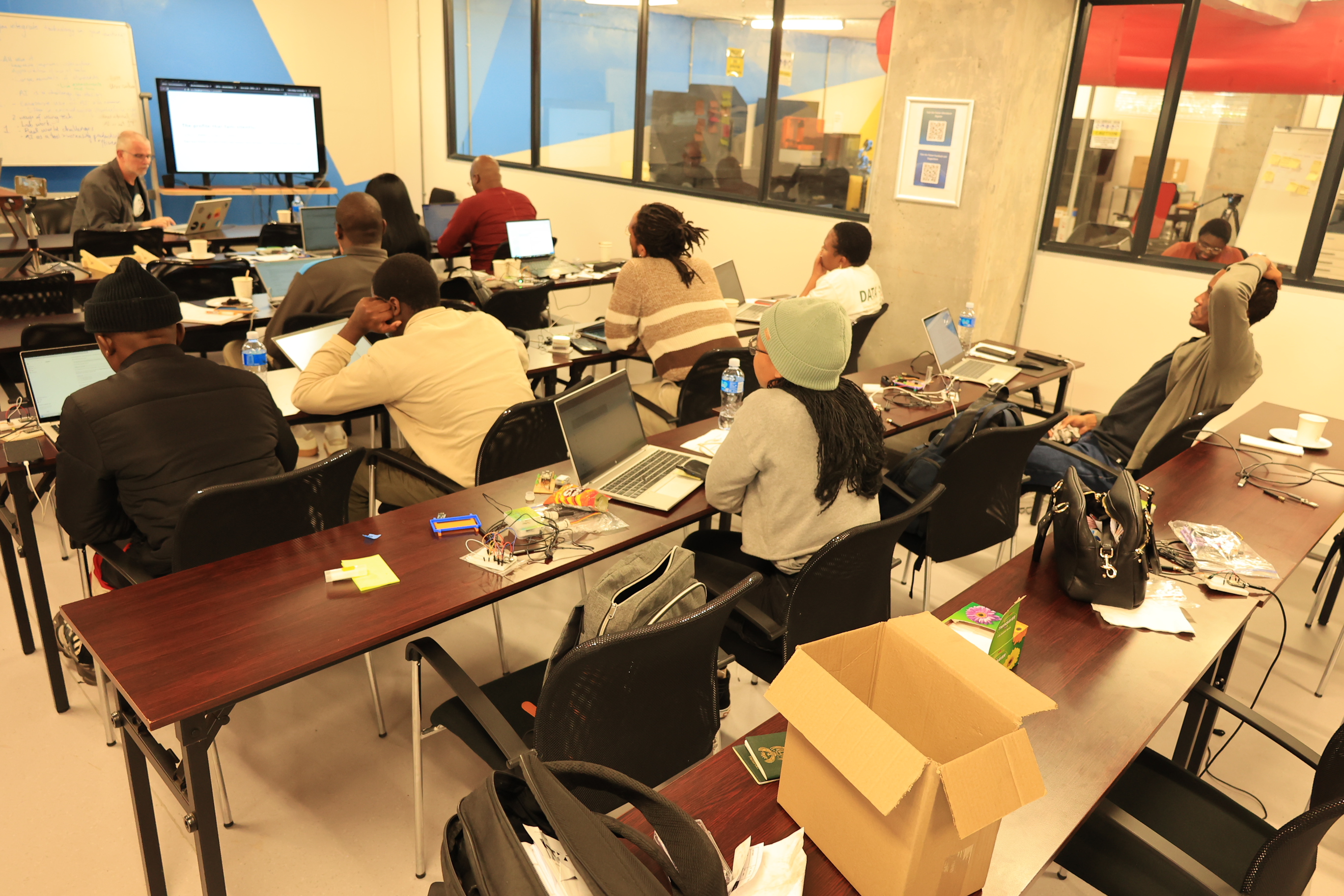
The experience of running the workshop proved decisive in September, when we ran a train-the-trainers week at the Wits Innovation Centre in Johannesburg for staff from six of our partner universities: the University of the Witwatersrand (host), the University of Fort Hare, the University of Botswana, the University of Zambia, the Namibia University of Science and Technology and the University of Dar es Salaam. A supplier failed to deliver part of the planned hardware, so we carried equipment from Leeds and ran the week on the kit, documentation and session structure developed for Hebden Bridge. Our partners built, registered and ran their own nodes, and gateway equipment plus sensor nodes remained with the Wits Innovation Centre for teaching their own students.
Next at Bridge Rectifier is a series of follow-up sessions built around the Universal Arlo Board, a new sensor board now in design based on the veroboard layouts from the workshops, with a build pack for each participant, and the first steps towards the co-operative.
A modest community award acted as the test bed for an international programme, and as the starting point for a community-owned one: a clear example of the local-to-global exchange that we all aspire to demonstrate.
Original Proposal
We're proposing a community workshop weekend at Bridge Rectifier hackspace in Hebden Bridge on Saturday 9 and Sunday 10 May 2026. On the Saturday, we'd like to run something like (tbd) an informal guided walk along the Calder Valley -- perhaps visiting Slow the Flow flood prevention sites and scoping the terrain for permanent sensor infrastructure. Additonally while simultaneously doing a signal-mapping survey of the valley using handheld Meshtastic devices. Pat ( who's as you know a BR, StF trustee and local flood warden) and perhaps we can draw on Dr Steph Bond (Leeds Geography
The Sunday is the main event: a full-day build workshop for around 15 participants. In the morning, everyone builds a complete LoRaWAN sensor node using a Heltec CubeCell dev board with an onboard LoRa radio, something like a BME280 environmental sensor, a battery, and an antenna. Each node joins a live LoRaWAN gateway running at BR and transmits data to a shared dashboard on the projector -- participants see their own sensor data appearing in real time the moment their build is working. The afternoon shifts into production mode: groups organised around real deployment partners (Steph's university monitoring site, Slow the Flow's flood infrastructure, and the ongoing Project Arlo prototype pipeline) build sensor nodes configured for actual field use. I'll be honest, his is where your lesson from Edinburgh -- keep the focus on the environment being sensed, not the code -- kinda shapes the approach.
The workshop connects to Project Arlo (ongoing open-source sensor prototyping at BR), which is also part of the DATA Project at Leeds, which is building community-owned LoRaWAN monitoring infrastructure in the UK and Southern Africa. The university is separately covering catering, student travel, and production pipeline hardware from its research budget, so the SSI contribution would go entirely toward participant kits and your suggestion of some durable workshop infrastructure.
Outcomes: 15 participants introduced to open-source environmental sensing, each leaving with a complete, working LoRaWAN sensor node they built themselves. Bridge Rectifier gains a set of durable workshop tools (e.g. soldering stations, hand tools, fume extraction fans, test equipment) that support ongoing community prototyping sessions well beyond this event. We generate a real LoRaWAN coverage map of the Hebden Bridge valley and begin building actual sensor nodes for three deployment sites. The workshop provides a documented, replicable model for your wider series (if of use ofc), we'll also share a HOWTO on our site as well.
Proposed budget:
- Participant sensor kits — CubeCell + BME280 + antenna + battery + breadboard + wires (×18 incl. spares): £450–500
- Durable workshop tooling for BR (soldering stations, hand tools, fume extraction, test equipment): £300–400
- Printed build guides and workshop materials: £50
- Contribution to Bridge Rectifier (hosting, utilities, wear and tear): £100